

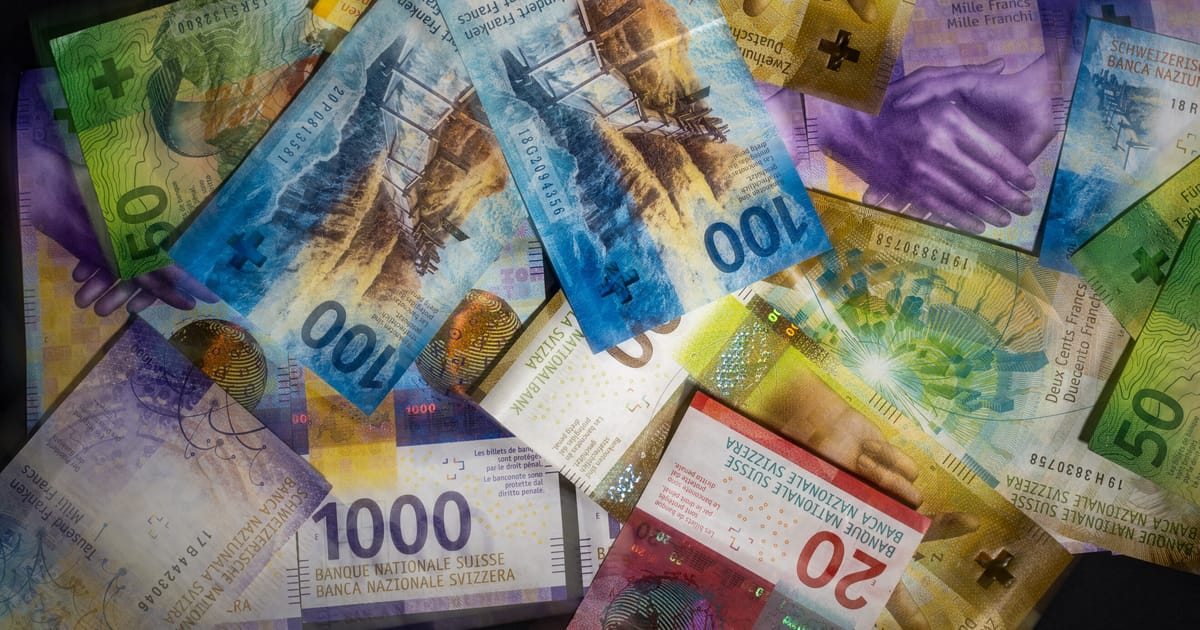
The right to use Swiss franc banknotes and coins will be enshrined in Switzerland’s constitution after voters on Sunday backed a measure designed to safeguard the use of cash in society.
I wish we the public had the right to vote on our constitution in the US. In the US the citizens don’t get to vote on constitution amendments. Only legislators get to vote.
Weird. They don’t follow their laws, why should you?
I don’t know if this would be a good idea for the USA.
US citizens voted Trump into power. Twice.
If anything, you guys should be given less rights to vote and be put under British rule again. /s
be put under British rule again
takes one look at the UK
… Thats not better right now
I wouldn’t be opposed to Canada puppeting the US around like Ratatouille.
I think that deciding on political/social issues should be preceded by a lengthy public discussion where experts and non-experts alike get to share all relevant information/viewpoints and ask questions to try and figure out the best way (or ways) to tackle the issue(s)
Adding a quote from the book “From What Is to What If” by Rob Hopkins:
While I was writing this book, my country has been enmeshed in the appalling contortions of Brexit, its withdrawal from the European Union. Brexit has been a disaster. Not because of the decision or its implications – I am not setting out in this book to express an opinion on that. The disaster was the process. The Brexit referendum took a highly complex issue, which most people didn’t really understand, and reduced it to a binary Yes or No. It was prey to massive amounts of misinformation and political interference, ‘dark money’ which influenced the vote, leaving a legacy of families and neighbours who don’t speak to one another, and a younger generation feeling betrayed by the older one. Did it have to be like that?
Neither campaign, Remain nor Leave, engaged the imagination in making their case. All we got were dry arguments about how much money we’d lose or save, and big red buses with fictitious numbers on how much the United Kingdom would be able to reinvest in its National Health Service if it left the EU painted on the side. No one argued for the brilliant creative flourishing that leaving the EU could bring about, a cultural renaissance, the chance to create vibrant local economies and opportunity for reconnection. Conversely, very few people argued that we should stay in the EU because being connected to Europe brings untold cultural delights, means we are working together for a common goal of unity, solidarity and peace and a flourishing of the arts. No, it was all about how many millions of pounds we might save, or are unnecessarily spending, and provoking a fear of immigrants.
The resultant decision was neither a carefully considered nor a wise collective response, and the divisions it created will endure for generations. And it meant that no one could think about anything else for years – squashing imaginative what-if questions about what kind of future we might actually want to embrace. But how might we have done it differently? How might we have had a national exploration of such a big and important question in such a way that our imaginations were invited, enhanced and treasured?
The answers can be found in a suite of techniques known as ‘deliberative democracy’. In essence, deliberative democracy refers to decision-making approaches that give people the opportunity to deliberate, to digest and to contemplate, in a safe context, particular issues. Ed Cox of the RSA (the Royal Society for the encouragement of Arts, Manufactures and Commerce), whose aim is ‘to enrich society through ideas and action’, suggests three principles that underpin it:
* Debate should be informed and informative, enabling people to explore issues from a range of perspectives based on sound argument rather than personality.
* Participants should be willing to talk and listen with civility and respect.
* Participants should represent a range of backgrounds and perspectives across the general population.
It covers a spectrum of approaches and tools, but central to them all is the making of considered judgements, spaces where people of different perspectives come together to deliberate in an informed and well-facilitated way.
30 some states voters can put constitutional amendments directly on the ballot with petitions for an up or down vote. That’s how marijuana was legalized.
That is for a state constitutional amendment. I was talking about the United States Constitution. For that constitution the citizens get zero say.
Well you can still propose one, and you could use the initiative process for your state’s assent even, but you need 3/4 of states to ratify it.
Better no changes than whatever these clowns would change it to anyway. People are too stupid right now, too manipulated, too dosed with industrial toxins a thousand times over, nothing better would result after the rich manipulate us.
Besides, the constitution is pretty good anyway. The bill of rights is solid. The problem is it’s not honored, changing the constitution means nothing if the government doesn’t follow it.
Obviously the electoral college sucks, nothing we can do about that now, but we can establish ranked choice voting in states with referendums, to change out output into that college.
The headline is wrong. The right to use cash wasn’t even part of it. It was pretty symbolic overall.
The original popular initiative:
Die Bundesverfassung wird wie folgt geändert:
Art. 99 Abs. 1bis und 5
1bis Der Bund stellt sicher, dass Münzen oder Banknoten immer in genügender Menge zur Verfügung stehen.
5 Der Ersatz des Schweizerfrankens durch eine andere Währung muss Volk und Ständen zur Abstimmung unterbreitet werden.My translation:
The federal constitution will be changed as follows:
Art. 99 Par. 1+ and 5
1+ The federal executive ensures that coins and bank notes are always available in sufficient amounts.
5 A replacement of the Swiss Franc by another currency must be put to a popular and cantonal vote.The counter proposal of the parliament we eventually voted for:
Die Bundesverfassung wird wie folgt geändert:
Art. 99 Abs. 1bis und 2bis
1bis Die schweizerische Währung ist der Franken.
2bis Die Schweizerische Nationalbank gewährleistet die Bargeldversorgung.My translation:
The federal constitution will be changed as follows:
Art. 99 Par. 1+ and 2+
1+ The Swiss currency is the Franc.
2+ The Swiss national bank ensures the cash supply.That’s literally the whole change.
Any ideas resembling forcing businesses to accept cash were dropped from discussion without making it into the proposal.
Edit: Here is a short version that’s even available in English on the Federal Council website: https://www.admin.ch/gov/en/start/documentation/votes/20260308/cash-nitiative-and-counter-proposal.html if you change the language in the top right to one of our national languages you can also download the PDF with the initiative text in the right sidebar, to verify my quotes.
Edit2: Added my translations
Edit3: In case anyone wants to know, I voted against both initiative and counter proposal. I just don’t see the point in a change without effect. Any change to national currency could already be overturned by popular referendum, if it was ever realistically proposed, whether it’s in the constitution or not. It just seemed like fear mongering by defeating a non-existent threat.
thx, as always international media is not capable of reporting correctly about swiss votes.
Yes, it’s common. Sometimes I’m too tired to even rage against it in the comments, but this one somehow got me 😄
That’s good to know. Thank you! I wish they would report it correctly. It’s annoying and frustrating when they sensationalize headlines.
What are the details on this law and its enforcement? Because surely it wouldn’t apply to some sectors, like online shopping. So I’m assuming only brick and mortar locations?
In Japan you can pay for online shopping with cash. The online store give you a code that ypu can use in a convenience store and pay with cash there.
I wish I was Japanese or Swiss. Not just because of the cash thing, a lot of reasons.
There is fuck-all actionable in there. No new duties for any store, nor even really the national bank as providing cash was already its job… Please see my other comment for the change: https://discuss.tchncs.de/comment/24440569
I’m assuming only brick and mortar locations?
Even that can be a problem, here (Denmark) when you charge your EV, you generally have multiple options, either with credit card directly, or credit card through an app, or Mobile pay (A widely popular local to Denmark bank owned payment system), or with a “charging token”, which also works through an app, but works for a lot of different charging stations.
Common for all the options are that they are digital, and AFAIK none of them take cash, and I bet it would be a major pain for the companies to do that. And I have never heard anyone wanting it.
The title and description are actually wrong. Haven’t checked the article itself though. We did not vote on the right to use cash.
The original proposal was about the following two changes to the constitution:
- Specifying that a double majority is required to change the national currency to something other than the Swiss Franc
- Specifying that the government is responsible that there’s always enough cash available
That was rejected however, and what we actually accepted is the government’s counter proposal, which is to move the existing two laws referenced in the original proposal to the constitution instead.
The laws in question were:
- The Swiss Franc is the Swiss currency.
- The Swiss National Bank is responsible for the cash supply.
That’s what we actually accepted, and it’s literally just a legal reinforcement of the status quo, making them harder to change than they were before. No practical changes, as they were already laws beforehand.
Good question. I don’t know the answer. The article says this was just voted into law this past Sunday. It doesn’t go into detail about what sectors are affected. I’m guessing more information about it will come out over time.
No sector at all. See my other comment for the entire content of the change: https://discuss.tchncs.de/comment/24440569
Just read your comment. Thank you for clarifying. The article was short on details, so this is good to know.