
I hear some people say Spanish is hard but that looks tame in comparison to Japanese since first of all Spanish uses the Latin Alphabet with additional letters while Japanese does NOT use that at all (due to them having Kanji, Hiragana & Katakana). The reason why Spanish by some is considered “easy” are the amount of cognates present (i.e. reality > realidad) but the same word in Japanese translates to 現実 which is different, you get the picture.
The sentence structure in Japanese differs from both Spanish & English as it’s SOV while both Spanish & English are SVO that can screw speakers of ES & EN at first as it’s reverse of both languages, so keep in mind. Like this:
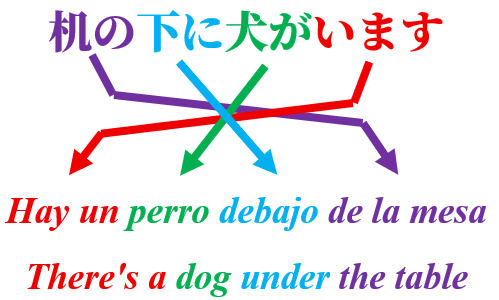
The real challenge for native speakers of both Spanish & English is Kanji as it’s logographic and the numerous readings a single character has (take into account of nanori, kunyomi & onyomi) which isn’t the case for an English speaker learning Spanish as the alphabet and writing systems are basically the same. I mean there are elements of Spanish that make it hard to learn (gender cases, subjunctive mood, verb conjugations, etc).
I mean, why do some people consider Spanish hard despite it using the same alphabet? (Although they are NOT part of the same linguistic branch, since English is considered Germanic like Dutch while Spanish is part of the Romance language group like Portuguese). But, in saying that: does that still make Japanese hard or rather simple when you take grammar, writing system, levels of politeness or formal speech into account?
You must log in or register to comment.
I can’t believe any English speaker would rank Spanish harder to learn than Japanese.
According to the US military, it takes 64 weeks to learn Japanese as a native English speaker as it would take 26 to learn Spanish as a native English speaker.
Say what you want about the US military, but they likely have a lot of data in learning how long it takes for native English speakers to learn other languages.
The language that is closer to your native language is easier. For English speakers, German would probably be easier than Spanish. For Chinese speakers, Japanese is easier. Personally, I don’t think learning any language is hard, but some people are better with numbers and visuals than with language.
Chinese and Japanese have very little in common except for the writing system Japan adopted and loanwords whose pronunciation has shifted substantially.
Yup, but getting the top certification in Japanese is easy if you know Chinese since it mostly tests kanji.
As a tourist, knowing Chinese helps a lot in Japan as well. Just beware of false friends
Just beware of false friends
you are right it’s just that this sounds really ominous
I saw something recently that made the argument that English has structures that act like kanji as well. The same is true for Spanish.
Consider the glyph 1. By itself you’d read it ‘one’, but then what about 1st, where it is read ‘fir-’? And then 10 and 11 don’t match either of those, or each other.
[tooth][paste] [corta][uñas] etc
deleted by creator
I think the hardest part of Spanish is conjugations, instead of adding a word they modify the verb itself in ways you have to get used to however, AFAIK pronunciation is quite consistent
spanish could be considered harder because it has a shit ton of personal pronouns and a lot of verb conjugations based on formality, time, and a lot of other shit, so you need to remember a lot these which makes it quite hard. japanese has some verb conjugation but it’s way easier in comparison to spanish. i say that if you’d remove kanji from the formulation spanish is harder, otherwise yeah, that complicates things a lot in japanese.
Personal pronouns and verb conjugations based on formality
Hoo boy, if you want to talk about vocabulary and grammar changes based on formality, that’s like Japanese’s whole thing.
One thing nobody’s mentioned in this thread is counters, which are little helper words attached to numbers. Which one you should use depends on what is being counted, the categories are highly idiosyncratic and generally have nothing to do with their ordinary use (e.g. 本, which elsewhere means “book” is the counter for long thin objects like pens or bananas), and there are dozens of them.
japanese formality system is not that hard, it’s a couple conjugations and it pretty much doesn’t change when it comes to gender, singular/plural, etc. it’s really exaggerated how difficult that is. spanish doesn’t have that many grammar rules for formality in that sense, but it adds another personal pronoun just for that.
also counters is also something shared among all languages pretty much. a school of fish? sure… it’s just whatever word/ideogram the language speakers decided it was what’s best to describe that group.
i’m not saying japanese is easy, just that some of those things are a bit not so much an issue as people make it seem to be. i am a native spanish speaker and i have practiced japanese for some time so i know a thing or two about that.
i suspect that spanish has japanese beat in this regard because of its relatively larger geographical dissemination makes formality based grammar rules incompatible with each other – effectively making all incompatible versions technically correct despite literally contradicting each other.
it’s one of the reasons why a majority of non-spanish speakers are taught european spanish rather than any of the SIGNIFICANTLY larger versions of spanish that exist.