CVE-2026-31431. 100% Reliable Linux LPE — no race, no per-distro offsets, page-cache write that bypasses on-disk file-integrity tools and crosses containers. Found by Xint Code.
Yea I didn’t think the post was that professional. Also the “unminified” version is just the minified with more white space. It still has poor names and no explanation of the binary blob.
Looking at the binary blob, it’s a payload to assume privileges as possible and exec sh. So replace su with that and the binary gets to use su’s filesystem privileges without needing access to actually write it.
The vulnerability part is when the door opens to replace any file’s read cache with arbitrary content. The binary payload is just an obvious example of the sort of payload that could do a ton of damage.
7.0-rc7 is probably due to the 7.0 release early mid april. So the fix was in the mainline on 1st of April. The commit on 11th from GKH was probably due to the release.
I am not that familiar with the commit and release structure to get more into detail. But to me it clearly looks like the statement on copy.fail is correct, that the fix was in mainline on 1st of April.
From my point of view, I would suggest that maybe the communication downstream to the distros was not handled that well? But who would be to blaim? The researches that would need to communicate this issue to most existing distros? Linux maintainers? Distro maintainers?
Hard to say, without knowing the communication of the related mailinglists and disclousre etc.


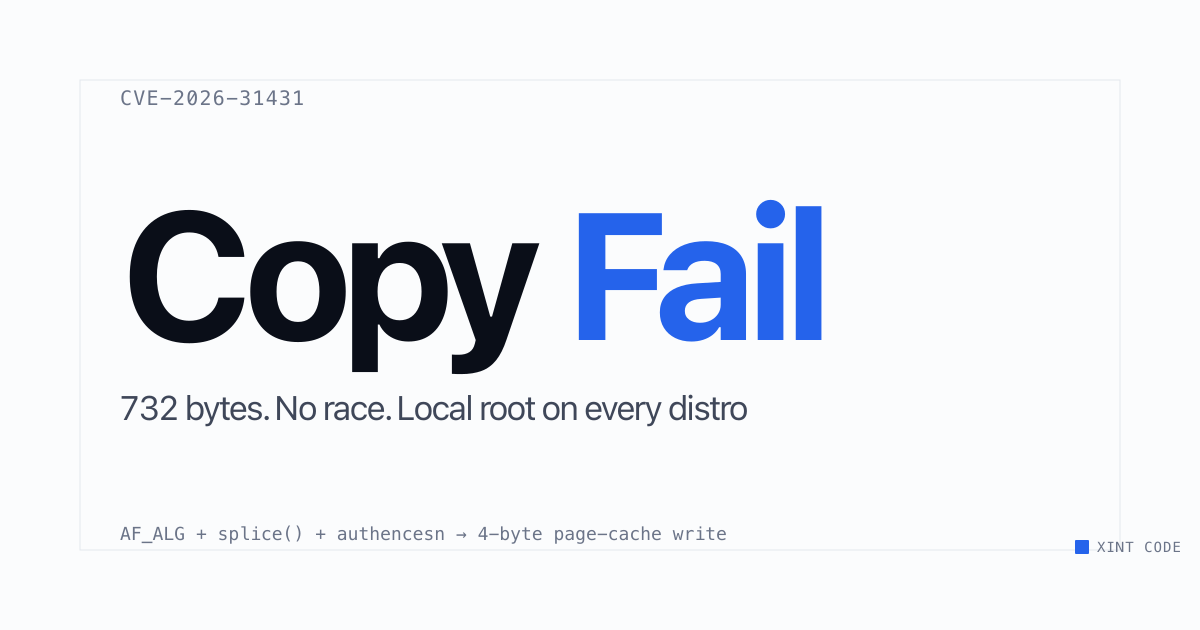
This disclosure has been rushed for the views and hype IMO, none of the big distros had fixes ready to go on this this morning.
Yea I didn’t think the post was that professional. Also the “unminified” version is just the minified with more white space. It still has poor names and no explanation of the binary blob.
Looking at the binary blob, it’s a payload to assume privileges as possible and exec sh. So replace su with that and the binary gets to use su’s filesystem privileges without needing access to actually write it.
The vulnerability part is when the door opens to replace any file’s read cache with arbitrary content. The binary payload is just an obvious example of the sort of payload that could do a ton of damage.
tbh they could have boasted even less bytes by just having everything in a zlib.decompress()
The patches where proposed over a month ago and the patch to the kernel was commited on 1th of April.
Either the Vulnerability was not proper communicated to the distro maintainers or they were the ones sleeping.
This was probably executed as a responsible discllsure where clear timelines and release dates get communicated from the beginning.
I find it hard to blame the security team here when there was 1 month of time between first commited patch and release of the PoC.
are you sure? what I have seen in git patch dates is 11th for the unreleased 7.0, and yesterday for the LTS versions
Looking at the CVE on NIST,i found following commit which dates to 30.03
https://git.kernel.org/pub/scm/linux/kernel/git/stable/linux.git/commit/?id=a664bf3d603dc3bdcf9ae47cc21e0daec706d7a5
the debian cve tracker also links to that page, but they have written 7.0-rc7 besides it.
https://security-tracker.debian.org/tracker/CVE-2026-31431
the openwall link has some comments that talk about the delayed patches, Greg KH also commented.
7.0-rc7 is probably due to the 7.0 release early mid april. So the fix was in the mainline on 1st of April. The commit on 11th from GKH was probably due to the release.
I am not that familiar with the commit and release structure to get more into detail. But to me it clearly looks like the statement on copy.fail is correct, that the fix was in mainline on 1st of April.
From my point of view, I would suggest that maybe the communication downstream to the distros was not handled that well? But who would be to blaim? The researches that would need to communicate this issue to most existing distros? Linux maintainers? Distro maintainers?
Hard to say, without knowing the communication of the related mailinglists and disclousre etc.