

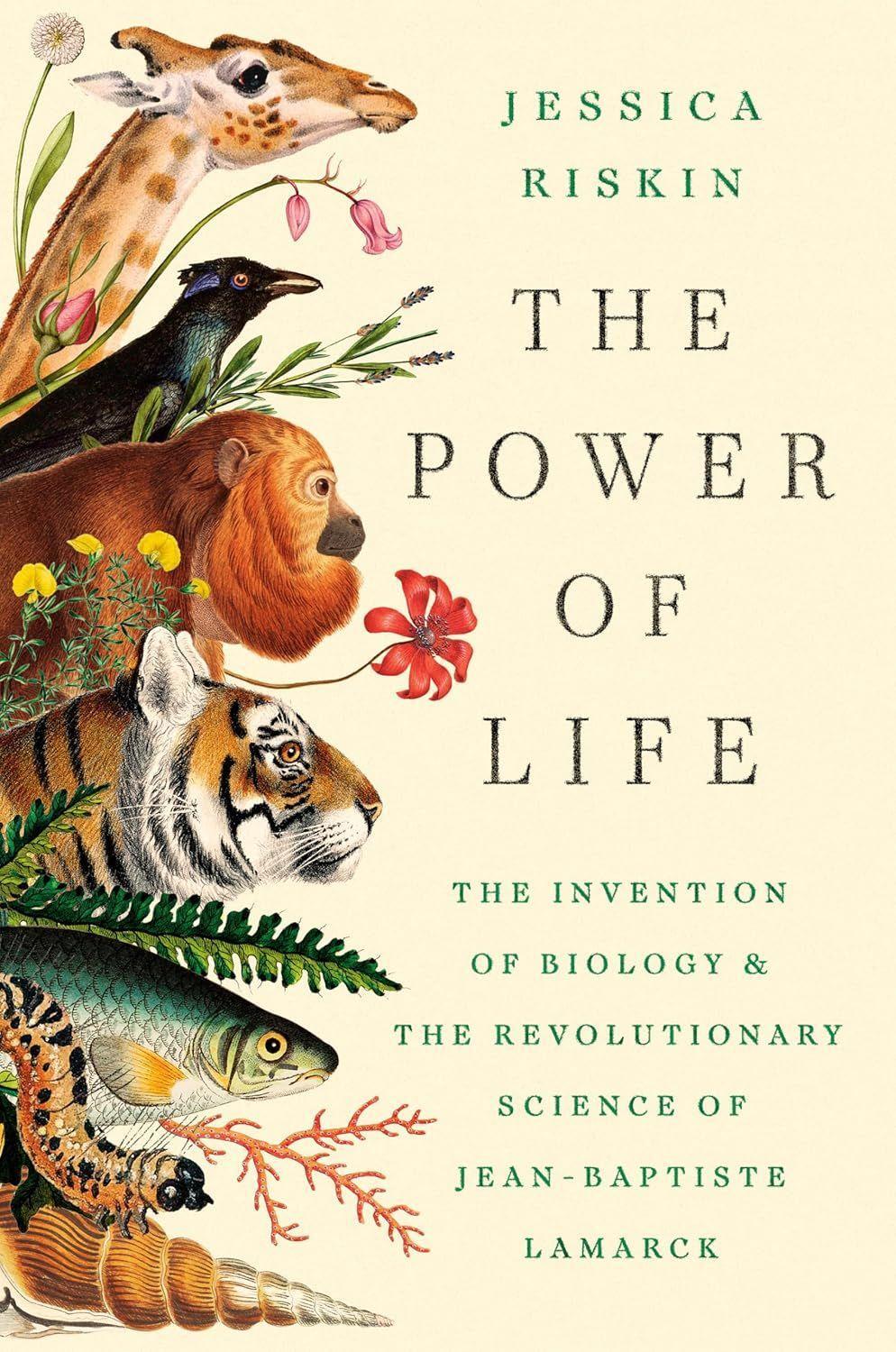
It’s that hollowing-out, Riskin suggests, that gives the sciences their sinister shadow. Genetics was preceded by eugenics; Darwin is still dogged (correctly or otherwise) by social Darwinism. In either case, and so many others, it’s not that “science” was infiltrated by a political (or poetical) poison. Rather, the very idea that science could be separate from such concerns allowed interested parties to bend it to their will. Science without poetry lacks imagination, but notably, it also lacks a moral compass.
What made Lamarck’s science “radical” was not that it was evolutionary or even materialist but that it was dynamic. Lamarckian science was always on the move, less predictable (and thus less controllable) than the mechanical dreams of those driven by the need to be right. Think of the garden and the workshop: what each affords, what each makes possible. In the Sciences of the Garden, humans bend themselves to the world as they find it; they watch and wait. In the Sciences of the Workshop, they bend the world—or try to—to their ends. Often, something breaks—and something has.
I can’t see how Lamarck’s theories can be seen as aligned with more “dynamic” theories like the extended evolutionary synthesis. The idea that an organism’s evolutionary potential is completely embodied by its current traits (even including epigenetically-transmitted traits like niche construction) renders it purely reactive: inert clay whose every change is dictated by the external pressures of natural selection.
A separately-transmitted genome with some components hidden from selection is the only way for organisms to evolve dynamic strategies for reacting to selection in ways not completely determined by their expressed traits.