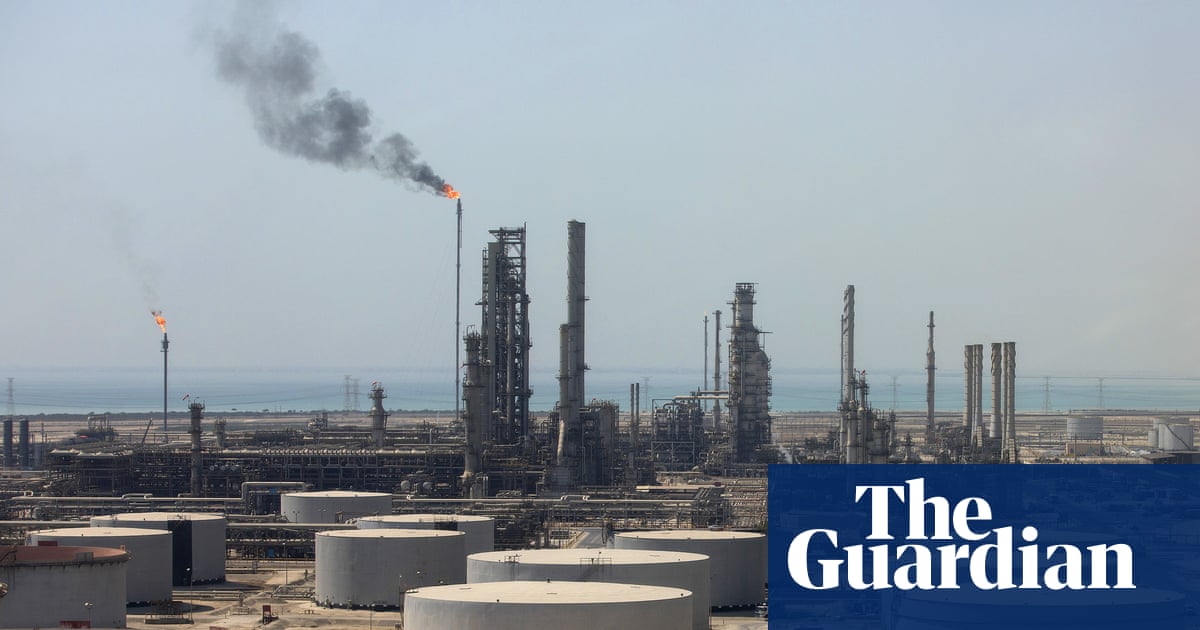
Just 32 fossil fuel companies were responsible for half the global carbon dioxide emissions driving the climate crisis in 2024, down from 36 a year earlier, a report has revealed.
Saudi Aramco was the biggest state-controlled polluter and ExxonMobil was the largest investor-owned polluter. Critics accused the leading fossil fuel companies of “sabotaging climate action” and “being on the wrong side of history” but said the emissions data was increasingly being used to hold the companies accountable.
State-owned fossil fuel producers made up 17 of the top 20 emitters in the Carbon Majors report, which the authors said underscored the political barriers to tackling global heating. All 17 are controlled by countries that opposed a proposed fossil fuel phaseout at the Cop30 UN climate summit in December, including Saudi Arabia, Russia, China, Iran, the United Arab Emirates and India. More than 80 other nations had backed the phaseout plan.
Saudi Aramco was responsible for 1.7bn tonnes of CO2, much of it from exported oil. If it were a country, Aramco would be the world’s fifth biggest carbon polluter, just behind Russia. ExxonMobil’s fossil fuel production led to 610m tonnes of CO2 – it would be the ninth biggest polluter, ahead of South Korea.
Yeah, turns out most of our CO2 emissions comes from fossil fuels which power most of our heating, manufacturing and transport, as well as form the foundational material for most products.
Who could have guessed that the things we do the most are the things that consume the most energy.

So when idiots say that there’s no point doing anything in your country because China, this may help to remind them which major polluters are owned or based in your country. For example, BP is the 8th-largest emitter, Shell is the 9th and both are based in the UK, so UK regulators could absolutely help clean them up and make a massive difference.
it’s a stupid metric tbh, the fuel is just what goes into (coal/gas) power plants, cars and planes to make them move, if you reduce the demand for those things naturally the demand for coal/gas/oil etc will go down
so UK regulators could absolutely help clean them up and make a massive difference.
They are :)
The government announced that the plan, published on Wednesday, will focus on funding solar panels, heat pumps and batteries for households across the UK via low-interest loans and grants.
https://www.bbc.com/news/articles/ckgj7me00p0o
All of these reduce demand for coal and gas, they also make having an EV more viable as cheaper power prices make running an EV even cheaper than it already is
They are :)
The government announced that the plan, published on Wednesday, will focus on funding solar panels, heat pumps and batteries for households across the UK via low-interest loans and grants.It’s a shame there’s no insulation plan to replace the mismanaged ECO4 programme for low-income homes, though. That’s another way to reduce demand.
Whenever this comes up it is important to realize that the way emissions are measured here is “product lifetime CO2 emissions”. The products are fuel. So basically it is just another way of saying " cars, airplanes and ships responsible for 50% of CO2 emissions ".
Also shares of heating, electricity, and production.